Figuring out the value of an irrational number without a calculator builds real number sense. Square root approximation challenge problems push students past simple memorization and force them to think about where numbers actually live on a number line. When you can estimate radicals quickly, you catch calculation errors and handle geometry problems involving the Pythagorean theorem much more easily.
What exactly are square root approximation challenge problems?
These are math exercises that ask you to estimate the value of a radical expression to a certain decimal place, or to order a mix of rational and irrational numbers from least to greatest. Instead of just knowing that the square root of 16 is 4, a challenge problem might ask you to figure out that the square root of 20 is roughly 4.47 and place it accurately between 4.4 and 4.5 on a number line.
Keeping a visual estimation reference sheet nearby helps students anchor their thinking to known perfect squares while they work through these tougher questions. The goal is to understand the size and scale of the numbers, not just to follow a rote algorithm.
When do students actually need to estimate radicals?
You run into this skill most often during standardized tests where calculators are banned. Test makers use these questions to see if a student truly understands what a square root represents. If a student guesses that the square root of 50 is 25, the teacher immediately knows they are confusing square roots with division.
This skill becomes especially obvious when working through geometry prep exercises that require finding diagonal lengths or hypotenuses. If you calculate a hypotenuse and get a radical, estimating its value tells you if your physical drawing makes sense or if you made a mistake somewhere in your algebra.
How do you solve these approximation challenges step-by-step?
Solving these problems relies on finding boundaries. Let us look at how to estimate the square root of 50 to the nearest tenth.
- Find the two perfect squares closest to your target number. For 50, those are 49 and 64.
- Identify the square roots of those boundaries. The square root of 49 is 7, and the square root of 64 is 8. This tells you the answer is somewhere between 7 and 8.
- Look at the distance. The number 50 is only one unit away from 49, but it is fourteen units away from 64. Therefore, the square root of 50 will be very close to 7.
- Test a decimal. Try 7.1. If you multiply 7.1 by 7.1, you get 50.41. That is slightly too high, so the square root of 50 is just a tiny bit less than 7.1, making 7.1 a highly accurate estimate to the nearest tenth.
Teachers often use a structured practice activity with an answer key to help students drill this bounding process until it becomes automatic.
What are the most common mistakes students make?
The biggest trap is assuming the relationship between numbers and their square roots is perfectly linear. Students often think that because 50 is roughly halfway between 49 and 64, the square root of 50 must be exactly 7.5. Square roots do not scale in a straight line. The gaps between square roots get smaller as the numbers get larger.
Another frequent error happens when ordering mixed sets of numbers. A student might correctly estimate the square root of 10 as 3.16, but then accidentally place it after 3.5 on a number line because they misread their own handwriting. If you are creating your own worksheets for these challenges, using a clear, readable typeface like Patrick Hand makes the numbers and decimal points much easier for students to read.
How can you practice this skill this week?
Getting better at estimating irrational numbers just takes a bit of targeted repetition. Follow this quick checklist to build your skills:
- Memorize the first fifteen perfect squares so you can instantly identify your boundary numbers without pausing.
- Practice squaring decimals in your head or on scratch paper to check your estimates.
- Draw physical number lines on paper and physically mark where the whole numbers and the estimated radicals sit.
- Mix up your practice by ordering sets that include negative square roots, fractions, and pi alongside your radical expressions.
Pick five random non-perfect squares today, find their bounding perfect squares, and estimate their values to the nearest tenth. Checking your work against a calculator at the very end will show you exactly how close your number sense really is.
Download Now Estimating Square Roots with Perfect Square Reference Sheets
 Quick Reference Sheets for Perfect Square Roots
 Mastering Square Roots for Geometry Preparation
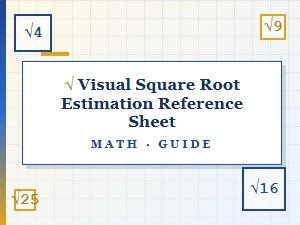 Visual Square Root Estimation Reference Sheet
 A Simple Guide to Estimating Square Roots by Hand
 Simple Ways to Estimate Square Roots