Middle school math introduces several abstract concepts, and figuring out roots that do not result in neat, whole numbers is often one of the biggest hurdles. Estimating square roots practice for middle school students matters because it builds genuine number sense. Instead of just pressing a button on a calculator, students learn to visualize where irrational numbers sit on a number line and understand the actual size of the values they are working with.
What does it mean to estimate a square root?
When you see a number like 20 under a radical symbol, there is no whole number that multiplies by itself to equal exactly 20. Estimating means finding the two perfect squares that your target number falls between. Since 20 is between the perfect squares 16 and 25, its square root must be between 4 and 5. The goal is to get as close to the actual decimal value as possible using mental math and logical guessing.
When do students actually need to approximate radicals?
Students run into non-perfect roots constantly in eighth-grade geometry and algebra. The most common situation is using the Pythagorean theorem to find the hypotenuse of a right triangle. If the legs are 3 and 4, the hypotenuse is exactly 5. But if the legs are 2 and 3, the hypotenuse is the square root of 13. To draw the triangle to scale or compare it to other lengths, the student needs to know that the square root of 13 is roughly 3.6. Approximating these values is also required when ordering real numbers from least to greatest on a number line.
How can students get better at mental estimation?
The best way to improve is by memorizing the perfect squares up to 144 or even 225. Once those are locked in, the estimation process becomes much faster. Students can also benefit from using a visual number line guide to physically see the distance between perfect squares. If a number is much closer to the lower perfect square, the decimal will be a .1, .2, or .3. If it is right in the middle, it will be around .5.
For example, look at the square root of 30. The closest perfect squares are 25 (root of 5) and 36 (root of 6). The distance between 25 and 36 is 11. The number 30 is 5 steps away from 25, which is slightly less than half the distance. Therefore, a highly accurate estimate would be 5.4 or 5.5.
What are the most common mistakes to watch out for?
When first learning this skill, students tend to make a few predictable errors. Recognizing these early saves a lot of frustration later on.
- Dividing by two: Some students see the square root of 50 and immediately think the answer is 25. They are confusing the square root operation with simple division.
- Ignoring the gap size: The gap between 1 and 4 is only 3, but the gap between 121 and 144 is 23. Students often forget that the intervals get wider, which changes how they should estimate the decimal portion.
- Rounding too early: When solving multi-step geometry problems, rounding the estimated root in the very first step can throw off the final answer completely.
Catching these errors is much easier when students check their work using a practice activity with a built-in answer key so they can instantly see where their logic went wrong.
How can teachers and parents support this learning?
Creating a low-pressure environment for trial and error is the best approach. Let students guess, check with a calculator, and then adjust their mental model. If you are a teacher designing your own custom worksheets for this topic, using a clear, readable typeface like Patrick Hand makes the math problems much easier for younger students to read and process.
Consistency is also important. Short, focused sessions work much better than long, grueling homework assignments. Incorporating targeted middle school math exercises into a daily warm-up routine helps solidify the concept without causing burnout.
Next steps for your next math session
Use this quick checklist to structure your next study or teaching session on approximating roots:
- Quiz the student on perfect squares from 1 to 144 until they can recall them instantly.
- Draw a blank number line and have them plot three non-perfect squares based purely on estimation.
- Check the plotted points with a calculator to see how close the guesses were.
- Apply the skill to a real-world geometry problem, like finding the diagonal of a rectangular TV screen.
 Estimating Square Roots with Perfect Square Reference Sheets
 Square Root Approximation Exercises Using Perfect Square Sheets
 Mastering Square Roots for Geometry Preparation
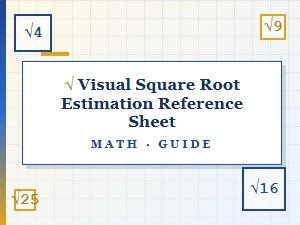 Visual Square Root Estimation Reference Sheet
 A Simple Guide to Estimating Square Roots by Hand
 Simple Ways to Estimate Square Roots